
CHEXX KYC in Nigeria: Documents, Verification Levels and Timing
CHEXX’s canonical KYC policy says verification is triggered if suspicious activity is detected, so Nigerian users should not treat the service as universally “no KYC”. Verification is handled through a separate account flow with multiple levels, and additional information can be requested when the account is subject to identity, compliance or recovery checks. The practical point is that verification is conditional rather than one identical sign-up step imposed on every account.
The useful point for Nigerian users is to avoid the misleading label “no KYC”. The platform has a real KYC process, an official document list and a defined verification area. If verification is requested or you choose to progress through the verification levels, the required material should be uploaded through the account’s Verification page rather than sent through an unofficial channel.
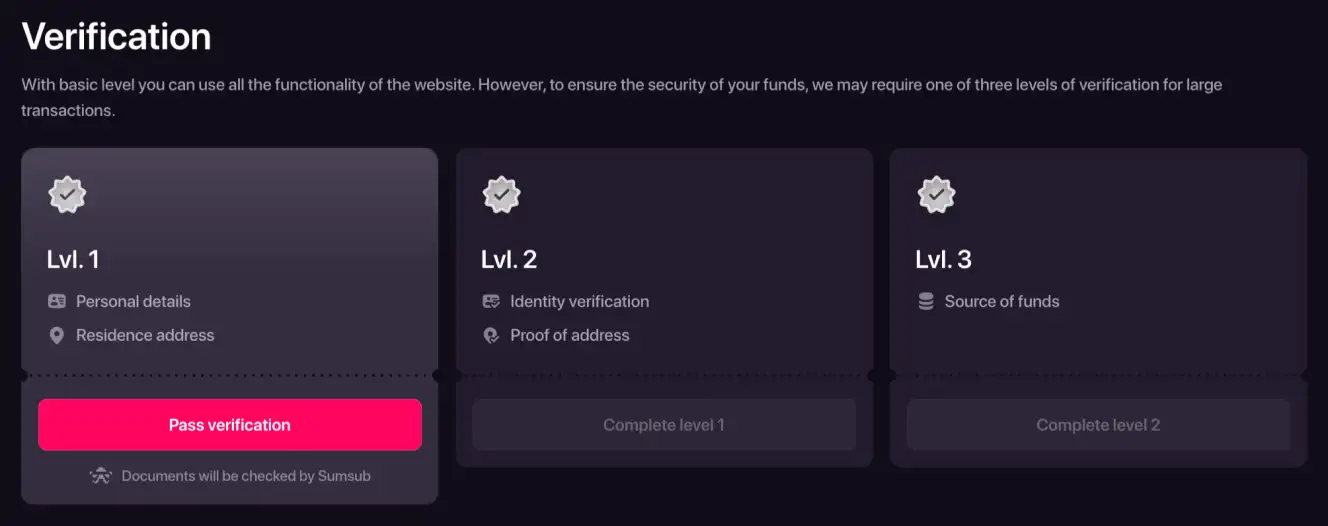
CHEXX KYC details
| KYC point | What CHEXX says |
|---|---|
| Separate verification area | Users can open Verification from the account profile and progress through verification levels. |
| Identity documents | Passport, national ID card or driving licence are listed as accepted identity documents. |
| Proof of address | Bank statement, tax statement, bank reference letter or utility bill are listed. |
| Source of funds | CHEXX lists several source-of-funds documents, including tax returns, bank statements and evidence of income or assets. |
| Typical review time | The Help Center says documents are usually checked within 5 minutes. |
| Maximum review time | The Help Center states a maximum of 72 hours for document verification. |
CHEXX can ask for additional documents when needed, so the listed documents are a standard accepted set rather than a guarantee that every user will be asked for exactly the same combination.
The three verification levels
CHEXX describes a sequential verification structure. Level 1 covers email and personal information. Level 2 adds identity verification and address confirmation. Level 3 adds confirmation of source of funds. The levels increase in order, and the Help Center says a user cannot move to the next level while a submitted verification request is still being processed.
Level 1
Email and personal information.
Level 2
Identity verification and proof of address.
Level 3
Source-of-funds confirmation.
This tiered structure is more useful than a binary “KYC or no KYC” label. It explains why one user can have a functioning account with only basic information while another is asked to submit documents before progressing further.
Accepted identity documents
The current CHEXX Help Center lists three identity-document categories: an international passport, a national ID card and a driving licence. For national ID cards and driving licences, the help article specifies both sides. A separate verification-criteria article repeats passport, ID card and driver’s licence as accepted identification documents.
CHEXX also gives practical photo-quality requirements. The document should be clearly visible, straight, free from filters and glare, and not turned upside down. The user’s face should be visible where a selfie-style verification step is involved. Poor image quality is specifically mentioned as a reason a document can fail review.
Proof of address and source of funds
For address verification, CHEXX lists a bank statement, tax statement, bank reference letter or utility bill. These documents are different from the identity-document set, so a passport alone should not be assumed to satisfy every verification level.
At the source-of-funds stage, the Help Center lists several examples, including a sale-purchase agreement, tax returns for the last two taxable years, a letter from a bank or accountant stating assets, bank or equities statements, paystubs showing the previous two years of income, and an accountant’s letter covering real-estate holdings or inheritance. CHEXX also says its team can request additional documents when necessary.
This is the stage where users should avoid uploading random financial records “just in case”. Follow the request shown in the Verification area and provide only what the account flow asks for through the official channel.
File format and upload limits
The document-list article accepts JPG, PDF and PNG uploads and states a maximum file size of 50 MB. That is useful when preparing scans from a phone because a clear image can still fail if it is saved in an unsupported format or is unnecessarily large.
Before uploading
- Use a clean image without filters or editing effects.
- Make sure all document edges and relevant data are visible.
- Avoid glare, deep shadows and blurry camera focus.
- Do not cover document data with fingers or other objects.
- Check the file type and size before starting the upload.
How long verification can take
CHEXX’s current verification-criteria article says documents are usually checked within 5 minutes, while some cases take longer. It also gives a maximum verification time of 72 hours. Those figures describe the operator’s stated review window, not a promise that every user will receive the same result at the same minute.
If a request remains in processing, the Help Center says you cannot move to the next verification level until the current one is completed. That makes it worth checking the live Verification page before repeatedly resubmitting the same material. Duplicate or lower-quality submissions can make troubleshooting harder rather than faster.
KYC can intersect with withdrawals without being the withdrawal process
CHEXX’s withdrawal flow and KYC flow are separate. A standard cashout involves selecting a crypto asset and network, entering the wallet address, confirming the amount and entering a six-digit email code. The Help Center also notes that an AML wallet check can be one reason a withdrawal is delayed.
If a withdrawal triggers an account or compliance review, follow the verification request shown in your account rather than assuming the cashout form itself proves which documents are needed. The CHEXX withdrawals covers the transaction side, while this page covers identity and compliance documents.
What to do if a document is rejected
Start with image quality. CHEXX specifically points to lighting, glare, document positioning and filters as common problems. The document should be upright, readable and complete. If a selfie or face image is required by the verification flow, the face should not be obscured by the document, sunglasses or a hat.
Then check whether you submitted the right document type for the right level. A proof-of-address document serves a different purpose from an identity document, and source-of-funds evidence is a separate category again. If the account asks for additional material, use the official Verification page and Help Center instructions rather than sending sensitive files to a social-media account or an address copied from an unofficial review.
Verified KYC facts and assumptions to avoid
The most useful way to read CHEXX’s verification material is to separate what the account flow actually shows from what a user might assume in advance. CHEXX has a dedicated Verification area and describes multiple verification levels, so KYC is a defined account process rather than a label that can be reduced to “KYC” or “no KYC”. At the same time, the existence of several levels does not mean every account will receive every possible request at the same moment.
| Point | Safe conclusion |
|---|---|
| Verification area exists | Use the account’s official Verification page when CHEXX requests identity or compliance information. |
| Verification has levels | Different checks can be requested at different stages; do not assume one universal document bundle applies to every account. |
| Requests can remain in processing | Check the live status before resubmitting material or trying to move to another verification level. |
| Withdrawal and KYC can intersect | A compliance review can affect a cashout, but the withdrawal form itself does not define which verification evidence is required. |
This distinction matters because a checklist copied from another user’s case can be misleading. The correct response is to follow the request attached to your own account, identify which verification level or issue it relates to, and submit information only through the official account flow. That approach reduces the risk of sending unnecessary sensitive material and keeps the verification request separate from unrelated registration or payment steps.
It also helps with troubleshooting. If a submission is rejected, first match the problem to the stage shown in the account: identity, address, source-of-funds or another requested check. Then review the file quality and the specific instruction for that stage before uploading again. If a request is still being processed, repeated submissions do not establish that a different document is required. The live Verification page is the relevant reference point for the status of the request.
KYC should change how you prepare, not how you panic
The practical takeaway is not that every CHEXX user will face the same document request. It is that the verification system is defined well enough that you can prepare for it. Keep access to your registered email, make sure your identity documents are current and readable, and know where to obtain a valid proof of address if the account reaches that level.
If you are still deciding whether to open an account, start with the CHEXX registration. If your main concern is who operates the site and under which licence, use the CHEXX trust and licence. KYC is one part of the account lifecycle, not a substitute for understanding the operator, funding model and withdrawal process as a whole. For the broader overview, see the CHEXX Nigeria review.
Prepared by the Chexx Casino editorial staff.